
For medical device manufacturers navigating the FDA’s 510(k) clearance process, few areas generate more documentation burden than biocompatibility. The data requirements are extensive, the scrutiny is high, and incomplete submissions routinely result in costly additional information requests. A powerful but underutilized strategy for reducing this burden is aligning biocompatibility testing with the Accreditation Scheme for Conformity Assessment (ASCA) and pairing ASCA-accredited testing with the FDA’s electronic Submission Template and Resource (eSTAR) tool.
NAMSA has been at the forefront of this approach. As the first biocompatibility laboratory in the United States to receive ASCA accreditation in the pilot phase in 2021, NAMSA offers manufacturers a unique advantage: test methods that are pre-vetted for regulatory acceptance and data generated by a laboratory whose processes have been independently assessed to meet the FDA’s own benchmarks.
| NAMSA Milestone: NAMSA became the original ASCA-accredited biocompatibility testing laboratory in the U.S. in 2021 and remains the only biocompatibility lab accredited for the entire panel of testing available, giving device manufacturers early access to a faster, more defensible regulatory pathway. |
What Is ASCA and Why Does It Matter?
The Accreditation Scheme for Conformity Assessment (ASCA) is an FDA program designed to streamline the review of medical device submissions by establishing a framework of pre-accepted, high-quality testing methods. Under ASCA, testing laboratories are initially audited and accredited by independent regulatory bodies to perform specific test methods. Following this, the US FDA evaluates the quality system and test methods of a laboratory before issuing ASCA accreditation for testing according to recognized consensus standards.
When a manufacturer submits summary reports generated by an ASCA-accredited laboratory, FDA reviewers can rely on that accreditation as evidence that the testing was properly conducted. Rather than verifying every procedural detail of the test, the FDA can focus its review on the scientific conclusions, reducing review time and the likelihood of additional information requests.
For biocompatibility, ASCA currently covers a range of ISO 10993 test methods, including sample preparation, cytotoxicity (MEM elution and direct contact), irritation studies (including skin irritation and intracutaneous), sensitization (Guinea Pig Maximization Test and Closed patch), Pyrogenicity, hemolysis, complement activation, and acute systemic toxicity. NAMSA is the only biocompatibility testing lab accredited for all eligible test methods in the ASCA biocompatibility program. These are precisely the tests that form the backbone of biocompatibility evaluations for most medical devices seeking market clearance.
The eSTAR Connection: Where ASCA Studies Pay Off
The FDA’s eSTAR (electronic Submission Template and Resource) is now the required format for most submissions. The eSTAR template is an interactive PDF format designed to standardize and guide applicants through the preparation of pre-market submissions. When preparing an FDA submission, the eSTAR PDF includes built-in sections for standards and conformity assessments, including a dedicated and detailed biocompatibility module. This module asks structured questions about each biocompatibility endpoint — the test method used, extraction conditions, study controls, results, and conclusions. Combining ASCA-verified test data within the eSTAR template results in a highly predictable, efficient pathway, heavily lowering the burden of evidence for both the manufacturer and the FDA reviewer.
For standard (non-ASCA) biocompatibility studies, the eSTAR biocompatibility section requires submitters to complete every field in granular detail. Consider a standard MEM Elution cytotoxicity entry: the submitter must document the extraction ratio, extraction vehicle, extraction conditions, pH adjustment status, study controls, assessment time points, scoring scale used, cell abnormalities, control performance, and the cytotoxic potential conclusion in addition to attaching the full test report.
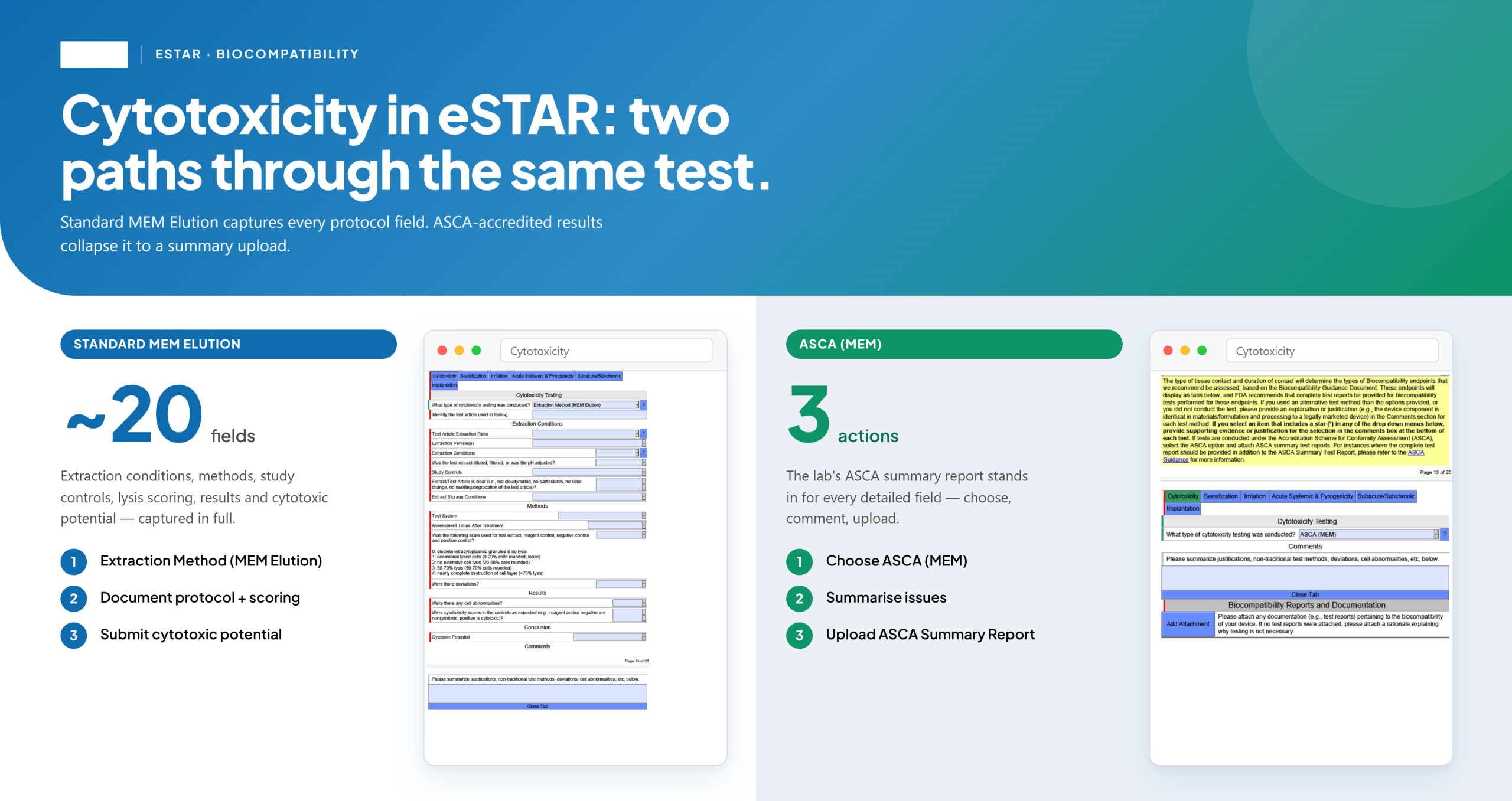
Figure 1. Standard MEM Elution cytotoxicity entry in eSTAR — requires completion of all extraction conditions, methods, results, and conclusions fields before the biocompatibility report can be uploaded. With ASCA submissions for cyto, only 3 small actions are needed.
This level of detail serves an important function; it gives FDA reviewers a structured summary of the study without requiring them to parse an entire test report. However, it also places a significant documentation burden on the submitter. A single biocompatibility evaluation covering six or more endpoints can require hours of form completion, and any inaccuracy or omission can trigger an additional information request that delays the review clock.
ASCA in eSTAR: A Dramatically Simplified Workflow
When biocompatibility testing has been performed by an ASCA-accredited laboratory, the eSTAR workflow changes substantially. Rather than completing every detailed field for each endpoint, the submitter simply selects the ASCA option from the test method dropdown, provides a summary of any notable issues or deviations, and uploads the ASCA Summary Test Report. Extensive field-by-field documentation that would otherwise be required is no longer necessary as the accreditation itself provides the FDA with the assurance that the testing was conducted correctly.
The below side-by-side comparison illustrates one of the most practical benefits of ASCA: a dramatically reduced documentation burden at the time of submission. When multiplied across numerous biocompatibility endpoints in a submission, the time savings can be substantial.
Table 1: Standard Testing vs. ASCA Testing: eSTAR Submission Requirements
| eSTAR Field Requirement | Standard Testing | ASCA Testing |
| Extraction conditions & vehicle | ✗ Required | ✓ Not required |
| Study controls & assessment times | ✗ Required | ✓ Not required |
| Scoring scale & cell abnormality detail | ✗ Required | ✓ Not required |
| Issue/deviation summary | ✗ Required | ✓ Brief summary only |
| Test report attachment | ✗ Full report | ✓ ASCA Summary Report |
| FDA review confidence | Varies by quality | ✓ Pre-validated |
ASCA Sensitization Testing: The Same Principle, Applied
The same streamlining benefit applies across other biocompatibility endpoints. Sensitization testing is one of the most required endpoints for implantable and skin-contacting devices and carries an equally complex eSTAR data entry profile under standard submission. A Guinea Pig Maximization Test (GPMT) requires documentation of induction injection details, challenge patch conditions and timing, animal condition throughout the study, Magnusson and Kligman scoring for both polar and non-polar extracts, positive control performance, and the sensitizing potential conclusion.
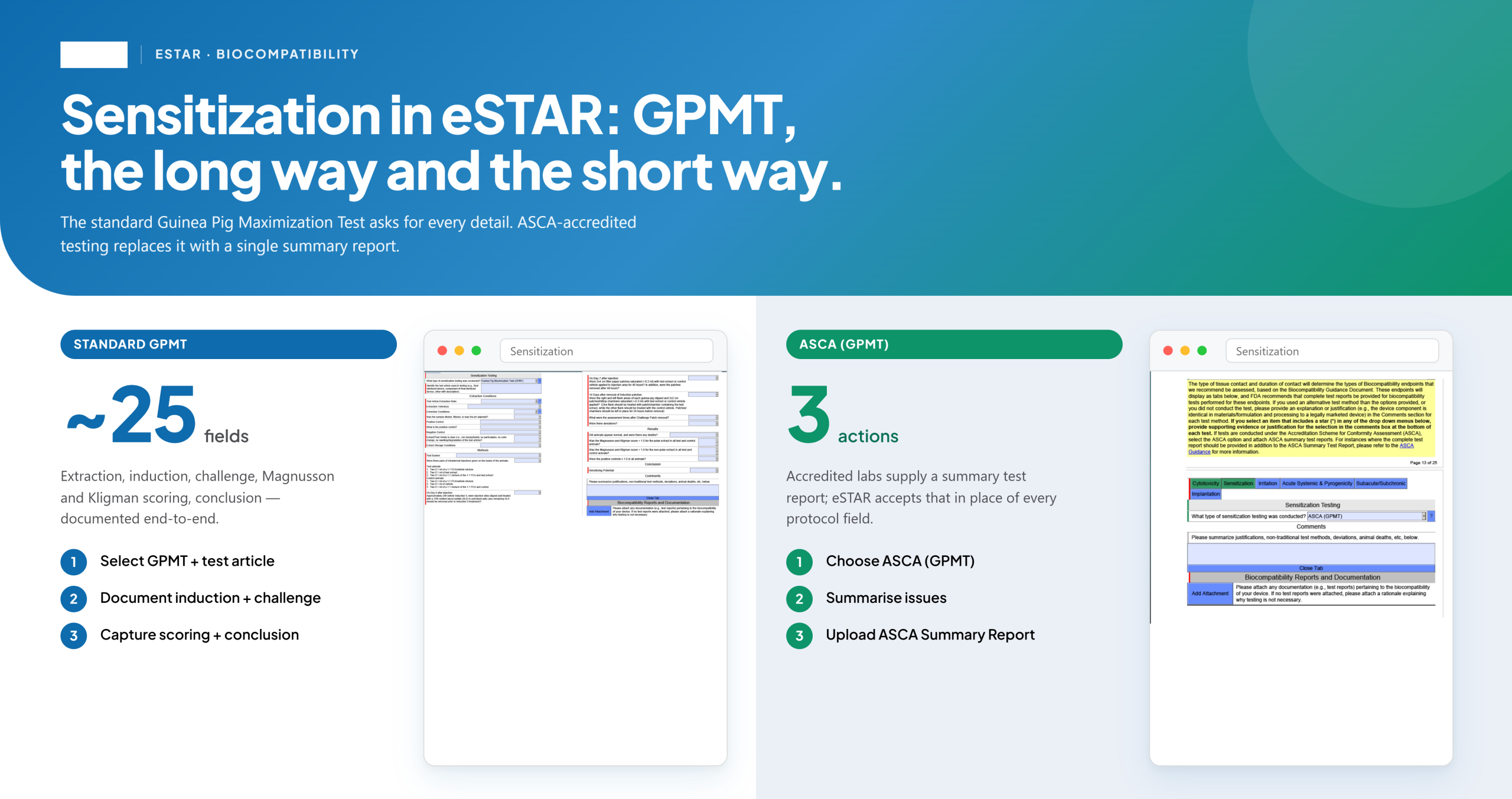
Figure 2. Standard GPMT sensitization entry in eSTAR — extensive fields covering extraction conditions, injection protocols, challenge patch parameters, scoring criteria, results, and conclusions must each be completed separately. With ASCA sensitization, only 3 small actions are needed.
Under the ASCA pathway, the Sensitization tab in eSTAR is streamlined in the same manner as Cytotoxicity. The submitter selects “ASCA (GPMT)” from the dropdown, the detailed field requirements collapse, and only a brief comments field and the ASCA Summary Report attachment remain.
| Key Insight: The eSTAR ASCA pathway is not simply a formatting convenience, it reflects the FDA’s formal recognition that ASCA-accredited testing meets their quality and completeness expectations, allowing review resources to be directed toward scientific evaluation of the device safety rather than procedural verification. |
By the Numbers: ASCA Adoption Is Accelerating
The FDA’s ASCA Annual Report for Calendar Year 2025 published by CDRH’s Division of Standards and Conformity Assessment provides compelling evidence that industry adoption of ASCA is growing rapidly, and that the program is delivering on its core promise of fewer deficiencies and information requests.
Submission Volume: 167% Year-Over-Year Growth
In 2025, the FDA received 136 device submissions containing ASCA Summary Test Reports; a 66% increase over 2024 (82 submissions) and a dramatic rise from just 51 total submissions across the program’s entire first two years (2022–2023) combined. That trajectory represents a 167% increase from 2023 to 2025, signaling a clear inflection point in manufacturer adoption.
| Period | ASCA Submissions to FDA | Year-over-Year Change |
| 2022–2023 combined (program launch) | 51 total | — |
| 2024 | 82 | +61% vs. prior year |
| 2025 | 136 | +66% vs. 2024 |
510(k) Dominance and Expanding Submission Types
Of the 136 ASCA submissions received in 2025, the overwhelming majority (123) were 510(k) premarket notifications confirming ASCA’s value for the clearance pathway most manufacturers rely on. The program also supported 7 De Novo submissions, 3 IDEs, and 3 PMAs, demonstrating that ASCA-accredited testing is applicable across the full range of FDA premarket pathways.
Quality of ASCA Submissions: Near-Perfect Performance
Perhaps the most powerful statistic in the 2025 Annual Report is the remarkably low rate of deficiencies in ASCA submissions. Out of 136 total submissions:
- Only 7 submissions (5.1%) had any deficiency compared to approximately 37% deficiency rates observed during the ASCA pilot phase prior to November 2023
- Only 1 submission required the FDA to request a complete test report, a less-than-1% rate that illustrates how rarely ASCA testing falls short of the FDA’s evidentiary expectations
The drop from ~37% deficiency rates during the pilot to ~5% in 2025 reflects the maturation of the program.
| Key Stat: In 2025, only 1 out of 136 ASCA submissions required FDA to request a full test report, a deficiency rate of less than 1%. For non-ASCA biocompatibility submissions, additional information requests remain among the most common causes of review delays. |
Biocompatibility-Specific Growth
Of the 136 ASCA submissions in 2025, 24 included biocompatibility testing, the scope directly supported by NAMSA’s ASCA accreditation. In recognition of the importance the FDA puts on the ASCA program, the FDA’s internal ASCA team dedicated 24 hands-on training sessions specific to biocompatibility submissions in 2025. As of year-end 2025, there are only 4 ASCA-accredited biocompatibility testing laboratories globally, demonstrating the difficulty of meeting the FDA’s rigorous standards for accreditation.
Strategic Benefits for Device Manufacturers
For manufacturers preparing submissions, the decision to use ASCA-accredited biocompatibility testing has implications beyond the submission form itself.
- Reduced additional information requests: One of the most common causes of review delays is an AI (Additional Information) request for incomplete or insufficiently detailed biocompatibility data. Because ASCA-accredited testing has been independently verified to meet FDA’s quality standards, submissions relying on this data are less likely to generate questions about how the testing was conducted.
- Faster internal submission preparation: The collapse of detailed eSTAR field requirements for each ASCA endpoint meaningfully reduces the time and expertise required to assemble the biocompatibility section. This is particularly valuable for companies with lean regulatory affairs teams or compressed timelines.
- Defensible testing: ASCA accreditation is granted based on rigorous assessment of laboratory quality systems, personnel competency, equipment calibration, and adherence to the specific test method. Reports generated under this framework provide a durable, evidentiary foundation for post-market queries, design change filings, and international regulatory submissions.
- Alignment with the FDA’s regulatory modernization priorities: The FDA has consistently signaled its commitment to risk-based, efficiency-oriented review practices. ASCA is part of that broader modernization effort. Manufacturers who build ASCA-compliant testing into their development programs are positioning themselves in alignment with where FDA review practice is heading.
Why NAMSA?
As the original ASCA-accredited biocompatibility testing laboratory in the United States, having achieved that designation in 2021, NAMSA brings unmatched experience to ASCA-aligned testing programs. As of year-end 2025, only four biocompatibility laboratories worldwide hold active ASCA Accreditation according to the FDA’s 2025 Annual Report. NAMSA was the first among them, and remains the only biocompatibility lab accredited for the entire panel of eligible test methods.
NAMSA operates as a full-service medical device testing and regulatory consulting organization. That means your biocompatibility program can be scoped, executed, documented, and translated into a submission-ready package by a single integrated team eliminating the translation gaps that often arise when testing and regulatory strategy are managed separately.
Whether you are planning a new device development program, preparing for a first submission, or reviewing an existing biocompatibility strategy for eSTAR compliance, NAMSA’s ASCA-accredited testing capabilities provide a meaningful competitive and regulatory advantage.
| Ready to optimize your biocompatibility strategy? Connect with NAMSA’s regulatory and testing experts to discuss how ASCA-accredited testing can accelerate your path to FDA clearance. |